


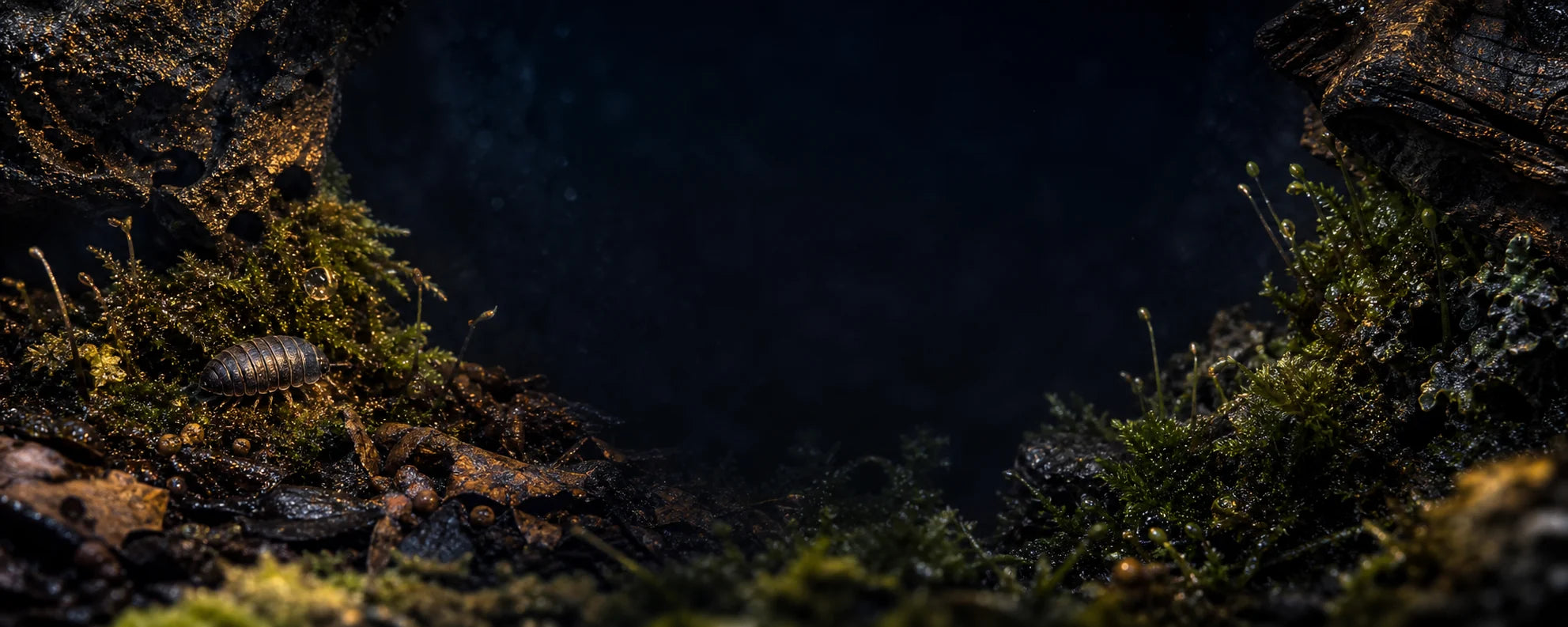
A bark slab does more than hide isopods. Its underside holds a buffered microclimate, supports microbial growth, creates grazing surface, and gives keepers a repeatable observation point. Poor placement can also compress substrate, trap a waterlogged pocket, or leave the entire hide on one extreme end of the enclosure.
The most useful hide crosses part of the moisture transition. One end can remain nearer the damp refuge while the other reaches a moderately drier zone. Animals can shift a short distance without leaving cover, and the keeper can compare distribution without excavating the bin.
Decision table
| What you observe | What it can mean | Useful next response |
|---|---|---|
| Adults and juveniles use different parts of one slab | The hide spans usable microconditions | Return it to the same orientation after checks |
| The underside is slimy and sour-smelling | Water and compression may be limiting air space | Lift, inspect locally, and correct the saturated pocket |
| Bark dries completely within a day | The surface refuge is not buffering moisture | Review hide size, substrate contact, and excessive airflow |
| Animals remain only under the wettest tip | Most covered area may be unusable | Compare moisture and heat before enlarging the wet zone |
A clean earthy smell and visible feeding marks can be normal. Colorful growth, softening wood, or fungal threads cannot be identified safely by appearance alone; judge recurrence, odor, location, and animal response.
Work through the question in order
- Select untreated bark with known source history and no paint, fragrance, resin treatment, or chemical residue.
- Use a piece large enough to create a gradient but light enough to lift without crushing animals beneath an edge.
- Set the slab on loose leaves or structured substrate rather than pressing it into mud.
- Mark the wet-end orientation on the lid so the hide is replaced consistently.
- Lift one edge slowly during checks, inspect over a tray, and lower it without sliding across animals.
- Add a second smaller refuge before colony density turns the only slab into a crowded observation bottleneck.
Bark is not a substitute for leaf litter or substrate. It creates cover and surface area, while the rest of the habitat supplies depth, food diversity, moisture storage, and escape from disturbance.
What not to conclude
- Using aromatic, treated, painted, or unknown landscaping bark because it looks decorative.
- Placing every hide entirely in the wettest zone and concluding that the species never uses drier shelter.
- Scrubbing all biofilm from sound bark during routine maintenance.
Sterility is not the goal of a detritivore culture. Source safety, structural function, and absence of a harmful pattern matter more than making the refuge look new.
Evidence, experience, and limits
Iowa State University Extension's terrarium care guidance explains how enclosure materials, moisture, and ventilation interact. It is plant-terrarium guidance, not an experiment comparing bark layouts for isopods.
Isopod King's house layout uses a main observation slab across the transition plus loose leaf layers and smaller pieces elsewhere. This is a practical setup method, not a claim that one bark area fits every colony.
A dated observation card for Bark Hides for Isopods: Surface Area, Moisture, and Safe Placement
Use one card for this question and keep unrelated experiments off it. On the opening check, record this action exactly: Select untreated bark with known source history and no paint, fragrance, resin treatment, or chemical residue. Also copy the first pattern you are watching: Adults and juveniles use different parts of one slab. Add the location, time of day, room condition, and any recent feeding or watering as context for this focus: Use bark as a stable observation refuge without flattening the moisture gradient or trapping stagnant wet pockets; a photograph from the same angle can support that record, but it should not replace notes about odor, substrate feel, movement, or life stages.
At the middle check, ask whether the observed pattern is spreading, shrinking, or simply moving. Compare it with this alternative: The underside is slimy and sour-smelling. Do not add a second correction just because the first response is not immediately visible. At the closing check, document the result of Add a second smaller refuge before colony density turns the only slab into a crowded observation bottleneck. If the result remains uncertain for the recorded focus - Use bark as a stable observation refuge without flattening the moisture gradient or trapping stagnant wet pockets - preserve the safest stable conditions and begin a new card rather than rewriting the first result from memory.
How to judge the result
Good placement produces multiple usable contact points, an underside that remains buffered rather than swampy, and a repeatable view of adults and young. A hide that becomes the colony's only tolerable location signals a habitat problem outside the bark.
Replace bark when it loses structure, becomes contaminated, or can no longer be lifted safely. Transfer animals and sound conditioned fragments carefully so maintenance does not erase the refuge network at once.
Continue through the Isopod King Care Library
- Build supporting substrate structure
- Place the hide across a gradient
- Keep leaf litter as the food base
- Scale refuge area to the colony
Scope: Wood safety depends on species identification, source history, treatment, and resident animals. This guide does not certify an unknown piece of bark. Editorial review: August 14, 2026.


