


Climate
Compare the culture's temperature guidance with the range your enclosure maintains—not a brief daytime peak.
Microfauna field guide
Browse live cultures below, then choose the format and count on each listing. Use the culture types and care links to find a match for your habitat.
Shop all springtailsTiny workers for living habitats
Springtails help occupy the damp, decomposing layer of a bioactive habitat. Choose a culture for the conditions you plan to maintain, then give it moisture, food, and time to establish.
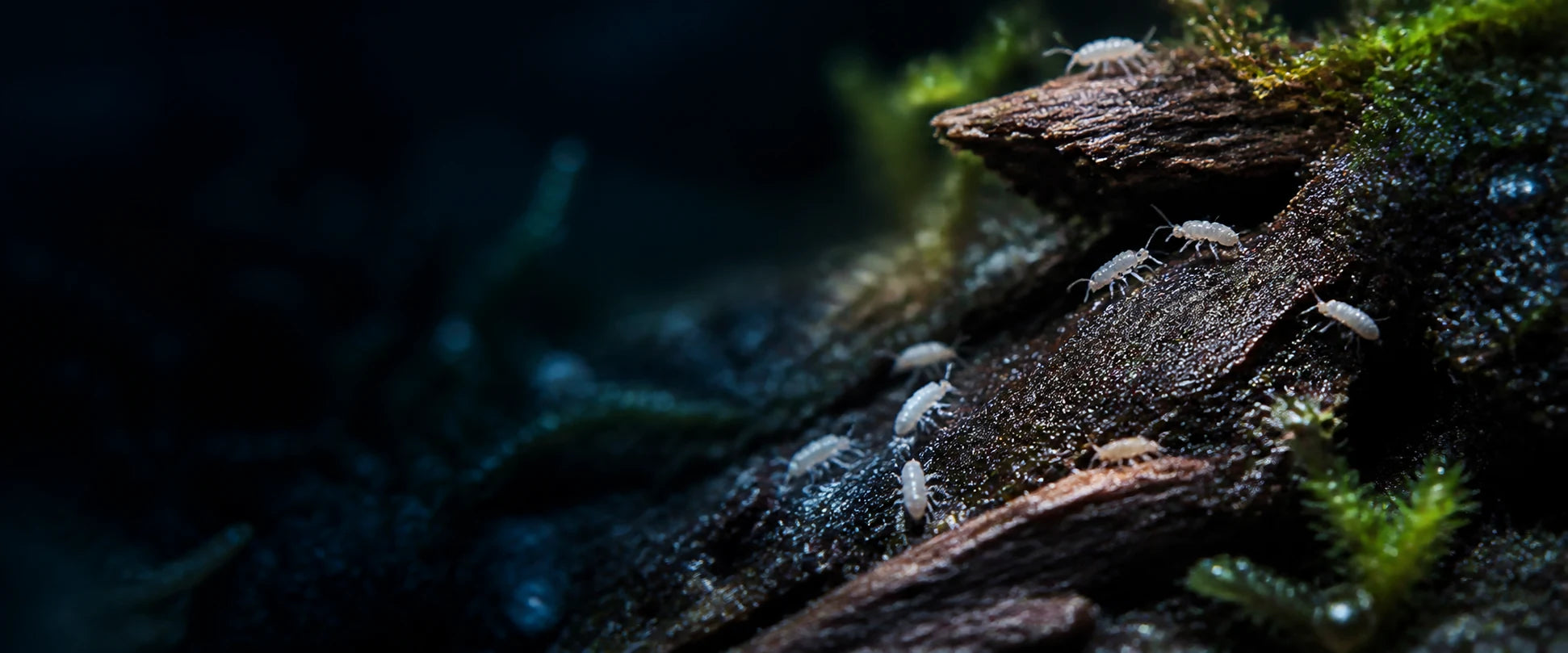
Choose for the habitat
Color may catch the eye, but the practical choice begins with the environment. Compare the culture's care information with the conditions inside your enclosure.
Review temperature and moisture guidance on each listing. A culture performs best when its needs align with the habitat you can maintain.
Charcoal, clay, substrate, and other media can change how a culture is maintained and transferred. Pick the workflow that makes sense for you.
Establish suitable moisture, decaying organic matter, and hiding spaces before adding springtails to a new habitat.
Small role, important layer
Springtails feed within the moist organic layer where leaf litter and other materials break down. They are one part of a bioactive system—not a replacement for sound ventilation, moisture control, spot cleaning, or responsible habitat maintenance.
Pair springtails with habitat materials selected for the culture and enclosure you are creating.
Shop care and habitat supplies
Shop by practical fit
These groups make the collection easier to scan. Always use the species listing for exact culture conditions.
A widely used culture for moderate, consistently moist setups.
Shop Temperate WhiteSmall white microfauna for warm, humid cultures and habitats.
Shop Tropical WhiteColor-forward cultures with species-specific moisture needs.
Shop OrangeTropical cultures chosen for both function and visible color.
Shop PinkLarger, more visible springtails for compatible culture conditions.
Shop GiantsDistinctive colors and forms for keepers ready to research the species.
Explore Collector TypesRead the enclosure first
Compare the culture's temperature guidance with the range your enclosure maintains—not a brief daytime peak.
Springtails need access to a damp decomposer zone, but the correct saturation and airflow differ among species.
Small soil-dwelling cultures prioritize function; larger or colorful species may be easier to observe.
Charcoal, clay, and substrate cultures have different transfer and maintenance routines. Choose one you can manage consistently.
Culture before release
Keep the culture moist, provide small measured feedings, and watch how quickly food disappears. A stable backup culture makes it easier to seed enclosures without exhausting the source colony.
Microfauna answers
Choose at the species level and let the product listing guide the exact culture routine.
They consume fungi, microbes, and fine decomposing material in moist areas. They support the decomposer community but do not replace enclosure maintenance.
They are commonly paired because they work at different scales. Whether a species combination is appropriate still depends on the enclosure conditions.
Temperate White and Tropical White cultures are common starting points, but the better choice is the one whose climate and culture method match your setup.
Feed small amounts according to the culture directions and wait for most of the previous portion to disappear. Overfeeding can encourage unwanted mold or mites.
That depends on the species, starting population, temperature, medium, and feeding. Look for sustained activity and reproduction rather than relying on one fixed number of days.
Springtail questions
Choose according to the enclosure's temperature, moisture, and intended use. Compare those conditions with each product listing rather than selecting by color alone.
No cleanup crew replaces proper habitat management. Springtails can feed on some decomposing material and fungi, while ventilation, moisture balance, and removal of problem material still matter.
Many keepers allow the bioactive layer time to settle and the cleanup crew time to establish. The appropriate timeline depends on the enclosure and species being housed.
The method depends on the culture medium. Follow the product-specific directions so you can transfer springtails while minimizing unwanted material in the habitat.
Maintained cultures generally need an appropriate food source. Use a product suited to the culture and avoid adding more than the population can use.
Build a living foundation
Connect your culture with the substrate, food, kit, and care information needed for the next step.


