


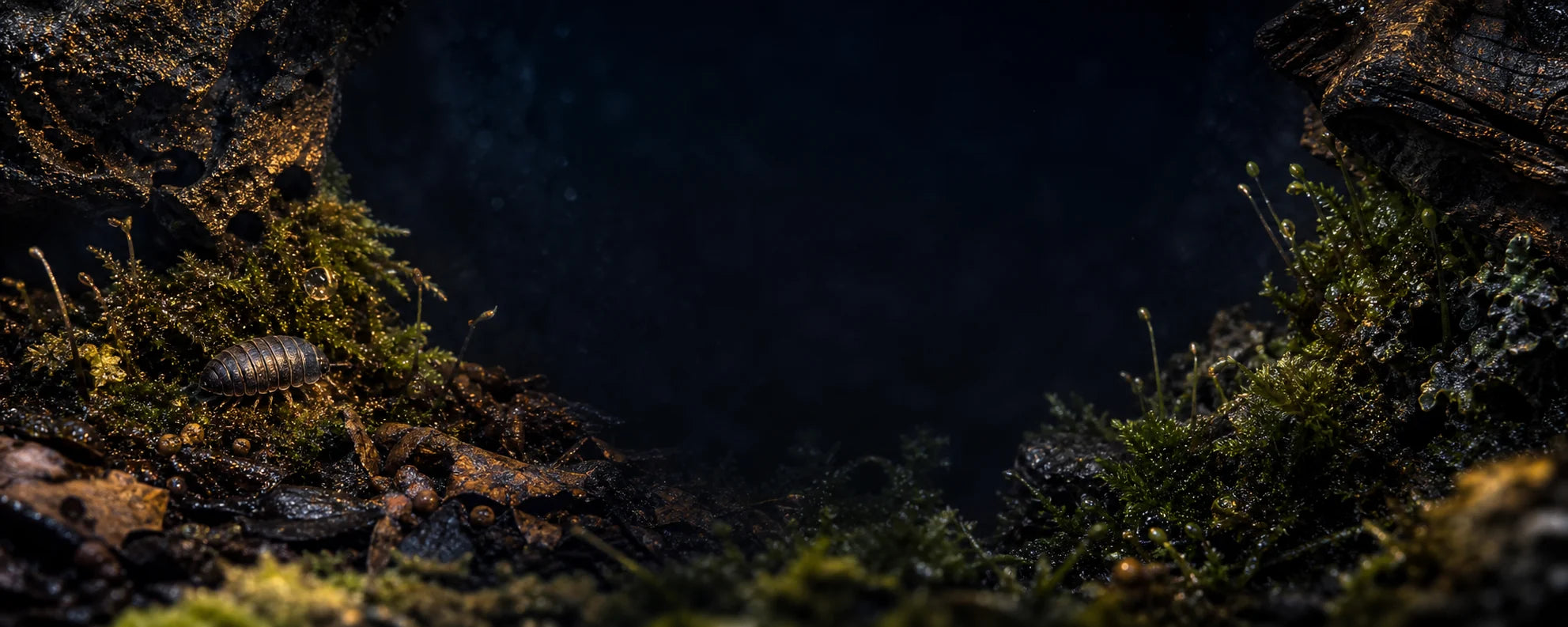
An isopod enclosure should not feel identical from one end to the other. Terrestrial isopods lose water readily and depend on humid refuges, but a uniformly saturated bin can reduce useful air space in the substrate, accelerate food spoilage, and leave the colony with nowhere to move when conditions become too wet. A moisture gradient solves that conflict by providing a consistently moist refuge, a transition zone, and a noticeably drier surface zone.
The goal is not to create a bone-dry half beside a swamp. The goal is to offer choices and then read how the animals use them. A single humidity reading cannot describe the moisture under moss, inside the substrate, beneath bark, and at the ventilated surface.
The three zones and what each one does
| Zone | What it should provide | Useful observations |
|---|---|---|
| Moist refuge | Consistent moisture in moss and the substrate below it; shelter for rehydration and molting | Material feels damp but does not release standing water; animals can move through it |
| Transition | A gradual change rather than a hard wet/dry line; leaf litter and bark spanning both conditions | Adults and juveniles can choose different depths and surfaces |
| Drier surface | More evaporation and fresh-air influence while deeper substrate retains some moisture | Leaves remain less soggy; supplemental food can be monitored and removed |
Place the damp refuge near one end rather than in the center. That preserves the longest possible transition. A hide crossing the transition is especially informative: lifting it briefly lets you see whether the colony is using the wet edge, the middle, or the drier edge without excavating the bin.
How to water the gradient
Add water to the refuge material and the substrate directly beneath it. Pouring slowly into one area usually builds deeper moisture more effectively than misting every surface. Misting can be useful for surface humidity, but it can make leaves look wet while lower substrate remains dry.
- Touch or gently compress the moss and upper substrate on the damp end.
- If both are beginning to dry, add a modest amount of water to that end only.
- Wait for the water to distribute before adding more.
- Check that the opposite surface still feels different. If the whole bin became equally wet, extend the interval before watering and reassess ventilation.
A rigid calendar is less useful than a repeatable check. Container size, substrate depth, vent area, room airflow, and season all change how quickly water leaves the system.
Read patterns, not isolated animals
| Pattern observed repeatedly | Possible explanation | Safe first check |
|---|---|---|
| Most animals packed into the dampest material | The rest of the enclosure may be too dry, especially below the surface | Check deeper substrate in the transition and drier zone before adding water everywhere |
| Animals avoiding the wet end | The refuge may be saturated, compacted, warm, or low in usable air space | Look for standing water, sour odor, compressed substrate, and heat near that end |
| Animals consistently at vents or lid edges | Conditions may be too warm, too wet, irritating, or otherwise unsuitable | Check temperature, recent additions, odor, and whether the pattern affects the whole colony |
| Normal activity across several zones | The enclosure is offering usable choices | Maintain the pattern and avoid changing several variables at once |
One animal in an unusual place does not diagnose the enclosure. Look for the same pattern across multiple checks and life stages. Nocturnal activity can also differ from what you see during the day.
Condensation is a clue, not a humidity meter
Condensation forms when humid air meets a cooler surface. It can appear after watering or when room temperature falls even if the substrate has not suddenly become wetter. Heavy, persistent fogging on every wall should prompt a check, but glass appearance alone does not tell you how much oxygen is available or how wet the lower substrate is.
Pair condensation with three observations: how the substrate feels below the surface, whether leaves and supplemental food stay soggy, and where the animals congregate. If all three suggest excess moisture, correct one factor at a time—usually watering volume/frequency or usable cross-ventilation—rather than opening the enclosure until everything dries abruptly.
A seven-day correction log
When the gradient seems wrong, record the same observations at roughly the same time each day: room temperature, condensation location, moist-refuge condition, transition condition, drier-surface condition, animal distribution, food condition, and any odor. Make one modest adjustment, then watch the trend. This is more reliable than alternating between flooding and emergency drying.
Published research on terrestrial isopod water balance and desiccation response supports the importance of moisture access, while also showing why species and temperature context matter. See this water-balance study and this temperature/desiccation study. Neither should be read as a universal hobby-care number.
Related Care Library guides
- Ventilation without drying the colony
- Cause-by-pattern mortality troubleshooting
- Beginner setup from start to finish
Scope: Moisture behavior varies among species, life stages, temperatures, and enclosure designs. Use this as an observation framework rather than a universal target. Last editorial review: August 13, 2026.


