


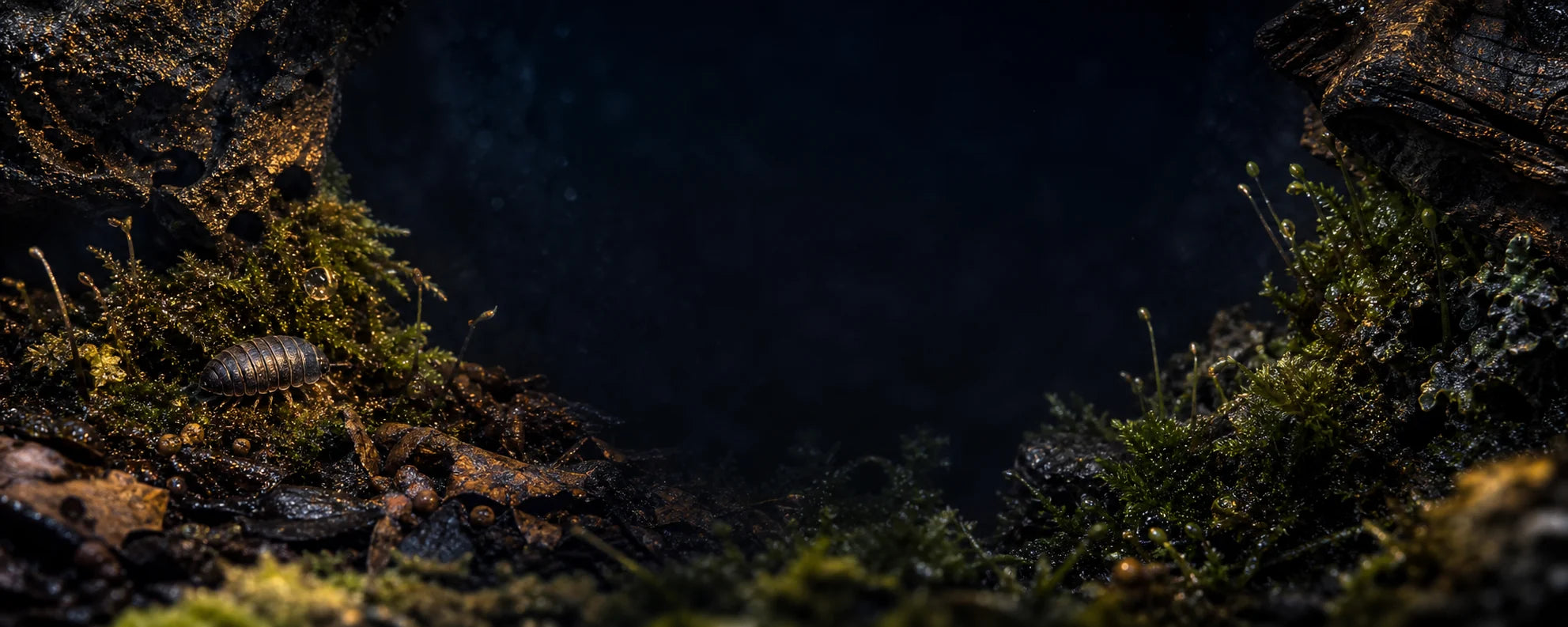
Know your companions
Porcellionides pruinosus
Powder Mix is the name of this Isopod King culture, listed as Porcellionides pruinosus. Keep the full culture label with your colony. Counts describe the group you order; they do not identify a different species or change its daily care. The named color or locality line belongs with its species identity; appearance can vary between individuals, ages and molts. Keep lines separate if you want to preserve their records.
This sheet belongs to the matching Isopod King listing. Check its selected count and current availability before ordering; the care guide does not change the product's options or shipping terms.
Build the stronghold
A refuge beneath the leaves
Prepare a secure culture with food-rich bedding, soft decayed wood and a generous leaf layer. Screen air openings carefully and work over a tray during maintenance, because these small isopods move quickly. Add multiple low shelters rather than a single crowded hide.
Choose clean, pesticide-free materials and substrate without fertilizer or other chemical additives. Do not rely on plain coco fiber as the whole food supply. Secure ventilation openings against escapes, place the enclosure away from direct sun, and prepare it before the animals arrive.
Give them a choice
Two paths through the habitat
Keep a damp moss-and-substrate refuge available at one end with drier leaf-covered space elsewhere. Maintain airflow and check sheltered bedding often enough to catch drying before it reaches the whole culture.
Air humidity alone cannot tell you whether the substrate under a hide is suitable. Check the refuge gently, keep cover in place, and adjust watering to ventilation and room conditions. Small juveniles need nearby sheltered moisture too.
Stock the royal pantry
Provisions for a living colony
Replenish leaves as the colony consumes them. Offer small amounts of suitable vegetable and protein foods, increasing only when the previous portion is being used. A productive colony can deplete its base food supply even while supplements remain available.
A suitable calcium source, such as cuttlebone, should remain accessible. Fresh and protein foods supplement the habitat's decaying plant material. Remove spoiled leftovers, reduce the next portion when food persists, and keep an eye on leaf cover as the colony grows.
Steady care, patient growth
Take up the colony watch
On arrival
Have the enclosure ready before opening the shipping container. Follow our arrival and acclimation guide, and give the colony a quiet place to settle.
During maintenance
Check moisture, leaf cover, leftovers and airflow. Observe a familiar shelter without overturning every hide. Watch leaf depth and crowding as closely as supplemental feeding, and plan extra space before the culture becomes crowded.
Give pale or molting animals space and avoid peeling away old shell. Females carry developing young in a brood pouch; growth varies with age, conditions and the starting group. Do not expect a fixed breeding timetable. Never release captive isopods outdoors.
A role in the living habitat
Every companion has a place
An established culture can contribute useful cleanup activity in a compatible bioactive enclosure. Keep a backup colony, review the needs of the main animal and monitor growth; no cleanup species makes waste management automatic.
Continue removing excessive waste and checking the needs of every inhabitant. A cleanup crew supports routine care; it does not replace it.
Observe before you adjust
Read the signs along the trail
| What you notice | First checks |
|---|---|
| Refuge drying out | Inspect beneath the moss; restore moisture gradually without flooding. |
| Mold on fresh food | Remove leftovers and review portion size, water and airflow. |
| An overheated enclosure | Check sunlight and nearby heaters; protect the culture from heat. |
| Repeated losses | Record conditions and recent changes. Send clear photos to our keeper team. |
These are habitat checks, not diagnoses. If problems continue, ask Isopod King for help before making several large changes at once.
From the keeper’s camp
Questions along the journey
Does the Powder Mix name change the care routine?
Use the needs of Porcellionides pruinosus as your starting point. The line name helps identify the culture, while moisture choice, shelter, food and stable conditions remain the foundations. Keep it separately labeled and confirm any source-colony differences before changing its setup.
How often should I water?
Use the condition of the damp refuge as your guide. Ventilation, substrate depth and room conditions change how quickly it dries, so check it and water selectively instead of following one fixed schedule.
Where can I continue learning?
Explore moisture gradients, feeding essentials and your first 30 days in the Care Archives.
Find your colony
Begin your Powder Mix colony story

Powder Mix Isopods
Porcellionides pruinosus
See the product page for current counts, prices, stock and shipping options.
The keeper’s journal
Your colony’s ongoing story
Watch leaf depth and crowding as closely as supplemental feeding, and plan extra space before the culture becomes crowded. A few short notes on watering, feeding, molts and enclosure changes help reveal patterns without constant disturbance.
- Keep a usable damp refuge.
- Replenish leaves, suitable wood and calcium.
- Remove spoiled supplements.
- Record changes and ask for help when needed.
Care guide reviewed October 27, 2026. Speak with the Isopod King keeper team →