


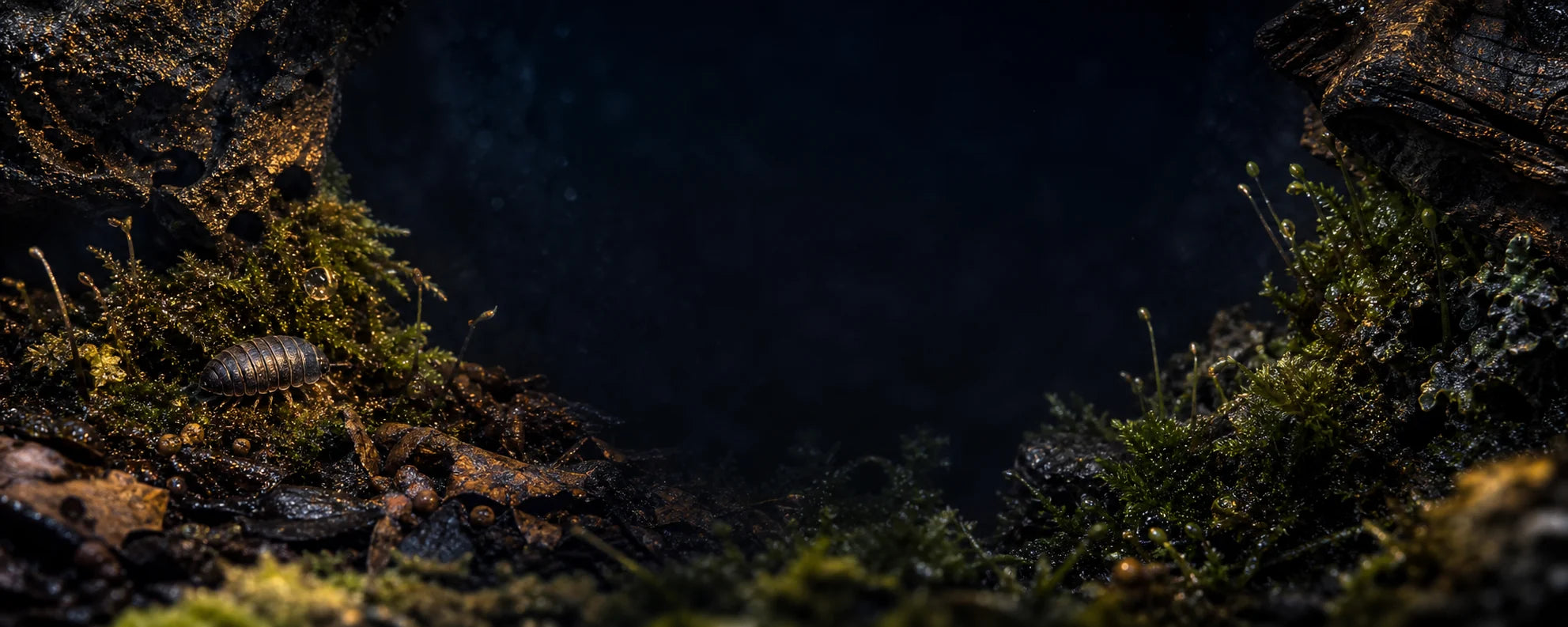
Most escaped isopods stay close to the enclosure and seek a dark, damp crevice. Act quickly, but do not spray the entire room or use pesticides that could affect other cultures and pets.
Secure the source
Close the enclosure, count open vents, and identify the route: warped lid, feeding gap, plant stem, loose mesh, or animals carried out on tools. Move the enclosure into a smooth-sided secondary tub while you repair it.
Search the likely zone
- Check directly under and behind the shelf.
- Lift nearby damp objects, cardboard, and floor mats.
- Inspect tool containers and discarded leaf bags.
- Use a flashlight along wall edges and cracks.
Set a moisture refuge
Place damp moss and a piece of bark in a shallow smooth-sided container near the escape point. Check after the room has been dark. Keep the trap damp, not flooded, and away from pets.
Prevent the next escape
Use intact lids, fine mesh on appropriately sized vents, clean rim surfaces, and a feeding routine that does not leave bark bridging the wall. Open bins inside a larger catch tub when handling fast species.
Quick checklist
- Enclosure isolated
- Nearby dark crevices checked
- Damp refuge placed
- Escape route repaired
Important: Do not intentionally release captive isopods or substrate outdoors. If a non-native species escaped outside, contact the appropriate local or state authority for guidance.
Review enclosure fundamentals in the beginner care guide.


