


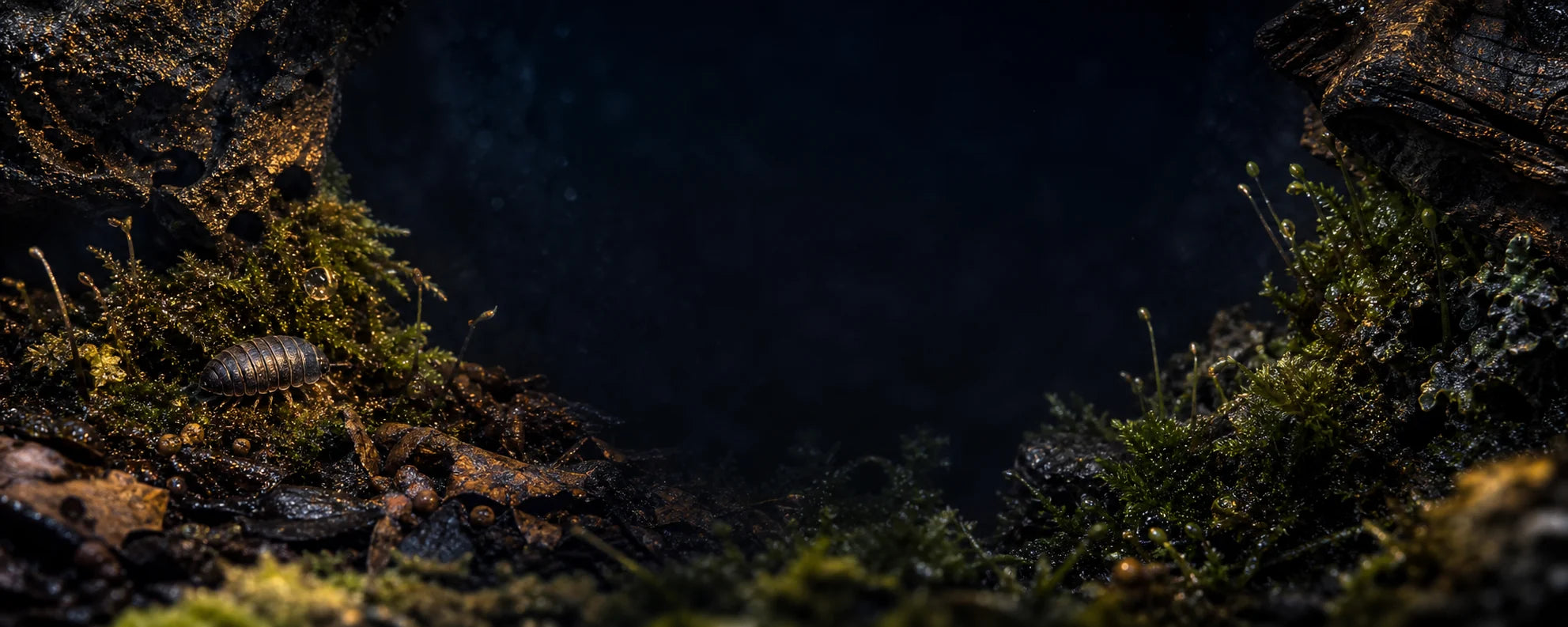
Most isopods are shelter-oriented and often more active when the room is dim. A healthy colony may spend the day under bark, inside leaves, or just below the surface. Visibility is not a reliable health score by itself.
Normal hiding
- Animals gather under bark but move normally when exposed.
- Food disappears overnight.
- Different age classes are present.
- The enclosure smells earthy and the moisture gradient remains intact.
Behavior that deserves investigation
- The entire colony climbs walls or ventilation holes.
- Animals crowd the only damp patch.
- They abandon damp substrate for the driest lid area.
- Previously active animals become sluggish after a temperature change.
Read location as information
Crowding at the moss may indicate the enclosure is too dry. Crowding high on dry bark can indicate saturation or stale substrate. Repeated clustering near one vent can point to poor airflow. Compare behavior on several days before making a large change.
Make observation easier
Use flat bark near the front wall, a small nighttime feeding station, and dim room light. Avoid removing cover simply to force visibility; that makes the habitat less secure.
Quick checklist
- Food use checked overnight
- Moisture gradient verified by touch
- No overheating
- No unusual odor or mass wall-climbing
Use the troubleshooting guide if hiding began after losses or a sudden environmental change.


